
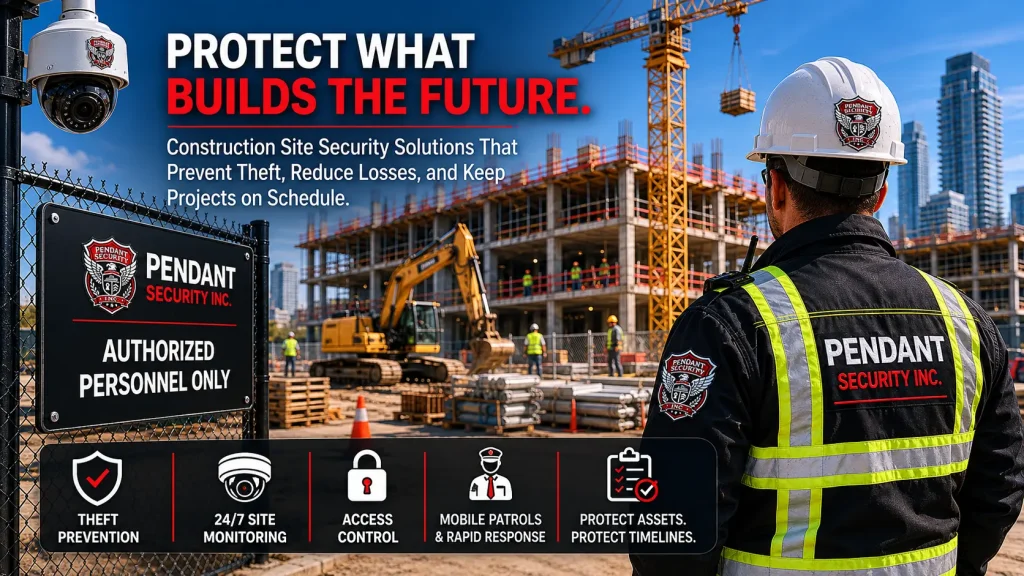
Construction sites across Canada continue to face increasing security challenges. From equipment theft and material losses to vandalism and unauthorized access, security incidents can create costly delays that impact project schedules, budgets, and operational efficiency. For developers, general contractors, and project managers, protecting a construction site requires more than fencing and signage. It requires a proactive security strategy designed to address evolving risks throughout every stage of a project.
Construction projects often involve significant investments in equipment, materials, labour, and infrastructure. When theft, damage, or operational disruptions occur, the consequences can extend far beyond the immediate financial loss. Delays in material delivery, equipment replacement, insurance claims, and project completion timelines can have a lasting impact on overall project success. As a result, construction security has become an increasingly important consideration for developers seeking to protect both assets and project outcomes.
“Construction security is not just about protecting equipment after hours. It’s about protecting timelines, controlling site access, reducing risk, and ensuring projects can move forward without unnecessary disruptions. The most successful projects treat security as an operational requirement, not an afterthought.”
Angelo, Project Coordinator, Pendant Security
As construction activity continues across the Greater Toronto Area and throughout Canada, developers are investing in more advanced security strategies to address emerging threats. Understanding how theft prevention, access control, surveillance, and rapid response capabilities work together can help construction teams reduce vulnerabilities and maintain project continuity.
Why Construction Sites Remain Attractive Targets for Theft and Vandalism
Construction sites often contain high-value assets that can be attractive to criminals. Equipment, tools, copper wiring, fuel supplies, building materials, and temporary infrastructure can all become targets for theft. In many cases, sites may be partially occupied, spread across large areas, or experience limited after-hours activity, creating additional security vulnerabilities.
Explore the latest trends, expert advice, and innovative solutions in construction site security. Developers and contractors are increasingly implementing layered security strategies that help reduce risk while supporting project operations.
- Reduced theft and vandalism risks
- Improved site access control
- Enhanced protection of equipment and materials
- Greater visibility across active job sites
- Faster incident response capabilities
- Improved operational continuity
The financial impact of construction theft can be substantial. Beyond the cost of replacing stolen equipment or materials, projects often face delays, scheduling disruptions, insurance complications, and increased labour expenses. Effective security planning helps minimize these risks while supporting project efficiency.
The Importance of Site Access Control and Perimeter Security
One of the most effective ways to reduce construction site risk is to control who enters the site and when access is permitted. Construction environments typically involve a wide range of personnel, including contractors, subcontractors, suppliers, inspectors, project managers, and visitors. Without proper access management procedures, unauthorized individuals can gain entry and create significant security concerns.
Site access control begins with clearly defined entry points, visitor management procedures, identification requirements, and perimeter protection measures. These controls help ensure that only authorized personnel are allowed on-site while providing accountability for site activity.
Perimeter security is equally important. Temporary fencing, controlled gates, monitored access points, surveillance technologies, and regular inspections help establish a visible security presence that discourages unauthorized activity. For larger projects, access management procedures may also include credential verification, contractor registration systems, and electronic access control technologies.
Construction developers increasingly recognize that access management is not solely a security function. It also supports site safety, contractor accountability, regulatory compliance, and operational efficiency. Well-managed access procedures contribute to a more organized and secure work environment.
Projects seeking stronger protection often implement specialized Construction Site Security programs designed to address the unique operational and security challenges associated with active job sites. These programs provide structured procedures, trained personnel, and proactive monitoring capabilities that help reduce exposure to risk.
As construction sites continue to evolve throughout different project phases, access control procedures can be adjusted to accommodate changing layouts, contractor activity, and operational requirements while maintaining consistent security standards.
How Mobile Patrols and Rapid Response Reduce Construction Site Risk
Construction sites are particularly vulnerable during evenings, weekends, holidays, and other periods of reduced activity. During these times, mobile patrol services and rapid response capabilities become essential components of an effective security strategy.
Mobile patrol teams provide visible deterrence through scheduled and randomized inspections of construction sites. Patrol personnel can verify perimeter integrity, inspect access points, identify suspicious activity, document security concerns, and respond to developing incidents before they escalate.
One of the primary advantages of mobile patrol services is flexibility. Patrol schedules can be customized based on project requirements, threat exposure, site size, and operational considerations. Randomized patrol patterns further reduce predictability, making it more difficult for potential offenders to identify vulnerabilities.
In addition to preventative patrols, rapid response capabilities provide immediate support when alarms are activated or suspicious activity is reported. Quick response times help reduce potential losses while improving overall site security.
Many developers integrate Mobile Patrol & Emergency Response services into broader construction security programs to strengthen after-hours protection and improve incident management capabilities. These services help maintain visibility across the project while providing additional reassurance to project stakeholders.
When combined with surveillance systems and access control measures, mobile patrol services create a layered approach to security that significantly enhances overall site protection.
Building a Comprehensive Construction Security Strategy
Effective construction security requires more than a single solution. The most successful projects utilize layered security strategies that combine personnel, technology, procedures, and ongoing risk assessment to address multiple threat vectors simultaneously.
A comprehensive security plan often begins with a site assessment that evaluates project scope, asset value, access points, surrounding environments, operating hours, and known security concerns. This assessment helps identify vulnerabilities and establish appropriate security measures.
Surveillance systems provide visibility across key areas of the site. Access control procedures regulate entry and exit activity. Mobile patrol services offer physical oversight and deterrence. Incident response plans help ensure security concerns are addressed quickly and effectively. Together, these measures create a more resilient security environment capable of adapting to changing project conditions.
Developers should also consider the long-term operational impact of security planning. Projects that incorporate security considerations early in the development process often experience fewer disruptions, stronger asset protection, and improved project continuity throughout construction.
Industry organizations such as the Canadian Construction Association (CCA) regularly highlight the importance of risk management, operational planning, safety, and security as critical components of successful project execution.
Ultimately, construction security is about more than preventing theft. It is about protecting project investments, maintaining operational momentum, supporting worker safety, and reducing the likelihood of costly disruptions. By adopting a proactive and integrated approach to site security, developers can better position their projects for success.
Every construction project presents unique security challenges. Whether you’re managing a residential development, commercial build, infrastructure project, or industrial site, a properly designed security strategy can help protect assets, reduce risk, and support project continuity.
If you’re evaluating ways to strengthen construction site security, Pendant Security can help assess your project’s specific requirements and recommend solutions that support both protection and operational efficiency. Contact our team today to discuss a customized construction security strategy designed around the needs of your project.